
Both humbled and bowled over by the incredible response to my book Bonsai, the Blue Sky way, I am truly grateful for all the heart-warming and amazing reviews. It has made the whole project of writing a book more than worthwhile—incredibly fulfilling and deeply satisfying. I’d recommend it to anyone who enjoys explaining stuff!

Many readers have found the bonsai task calendars in Bonsai, the Blue Sky Way particularly useful, so I’ve put together a summary to bring them all into one place for easy reference. This quick-glance view is a collection of excerpts from the book. If you already have the book, this should serve as a handy recap. And if you don’t, it offers a glimpse of the structured guidance inside!
Principles for bonsai calendars
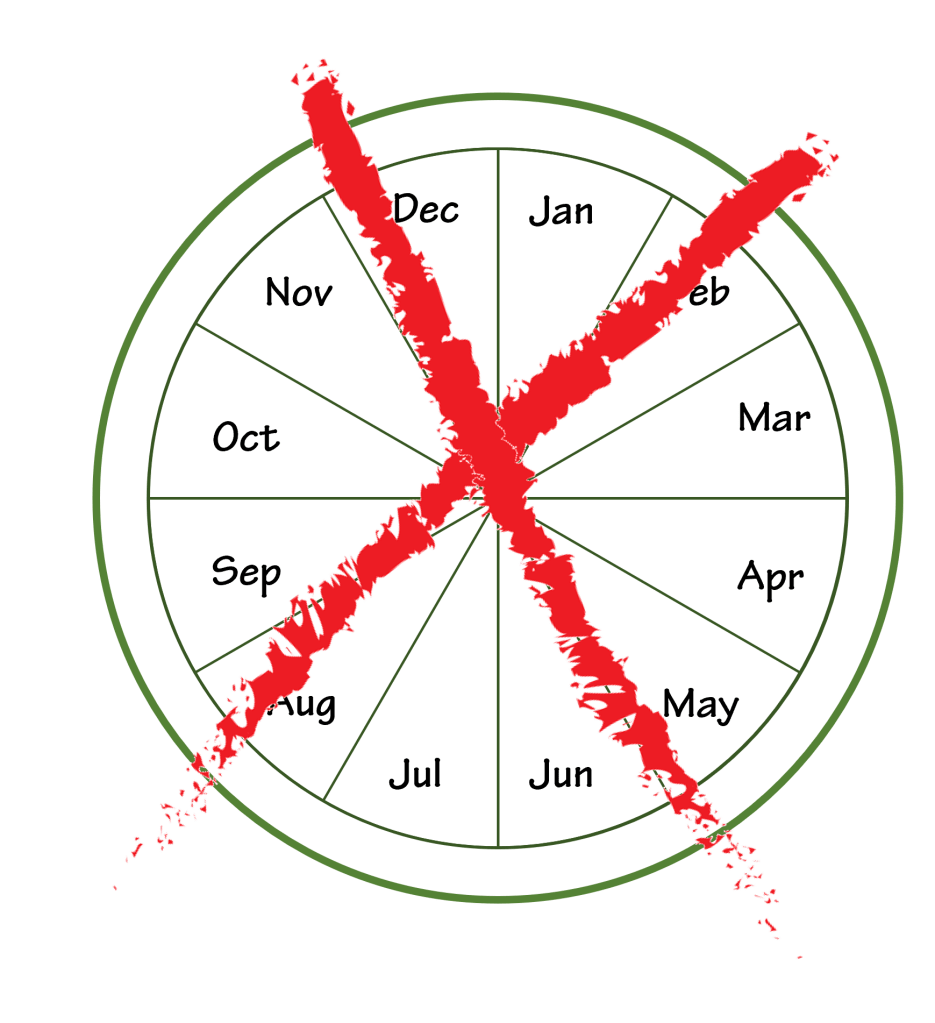
Firstly, and most importantly, let’s be mindful of the fact that the seasons are diametrically opposite between the north and south hemispheres, and even within a region, different species and climates experience slightly differing calendars. So, listing tasks by month would be at best inaccurate, and at worst misleading or just wrong, depending on where you live in the world. For this reason, my bonsai calendars are by season; not by month.
Energy Calendar
The key to understanding the branch and root pruning calendars is to understand the energy cycle of trees. In particular, deciduous and coniferous trees, leaving aside tropical species for now, since they can stay active all year round.
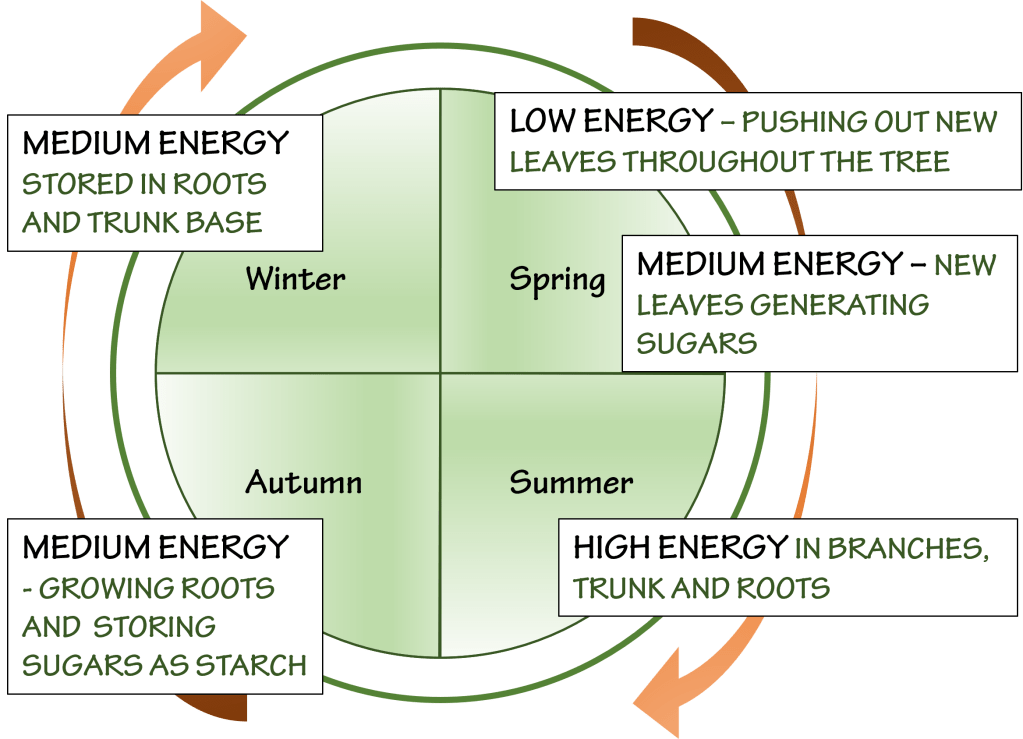
An important takeaway from the energy calendar is this: in spring when deciduous trees and conifers are pushing out new foliage all over the branches, at that time the energy reserves in the tree are low, as all the sap is being “used” for new growth. After the new foliage has fully grown and hardened, the tree is photosynthesizing new sugars and recuperating the tree’s energy.
Branch pruning calendar
Root pruning calendar
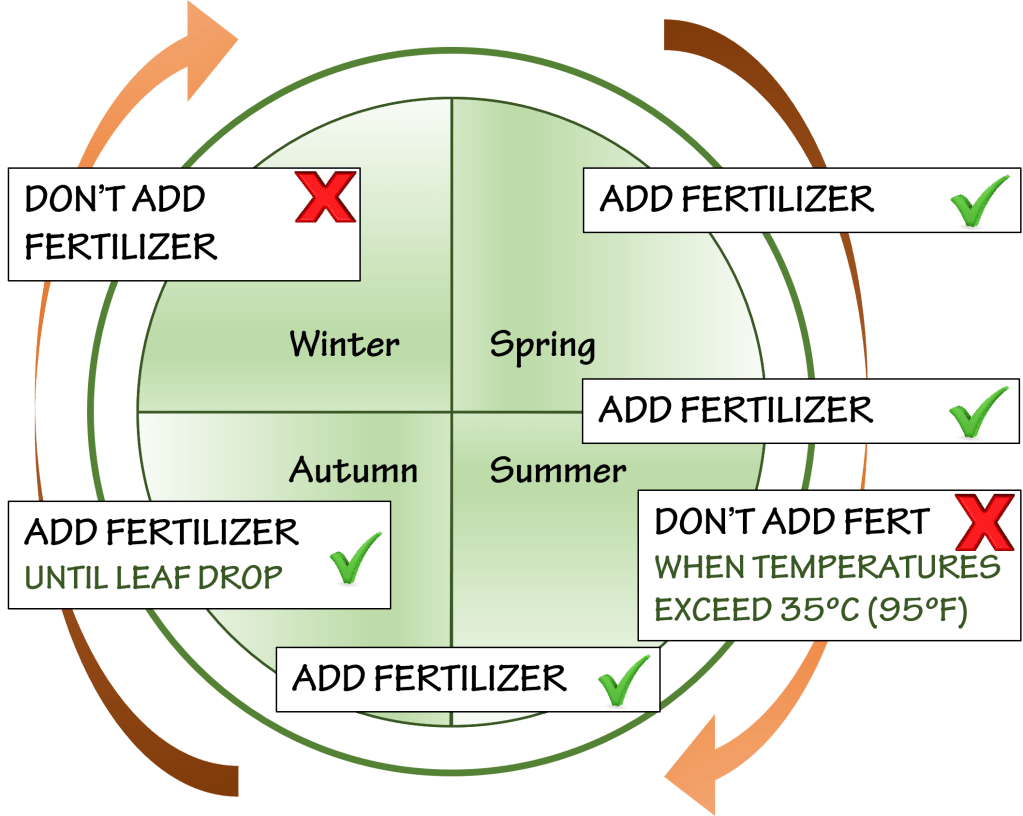
Fertilizer calendar
Explanations in brief
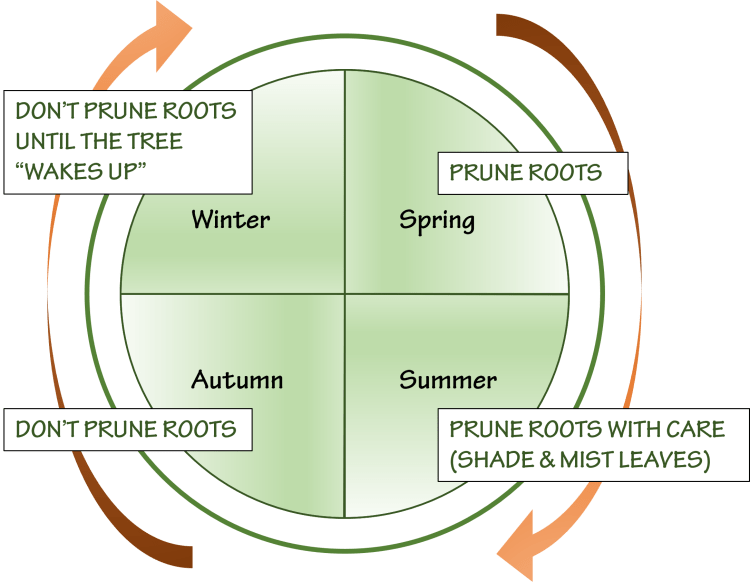
Pruning roots
Simply put, prune the roots as the tree is waking up, as you see the new buds swelling or just starting to unfurl. This is when the sap is surging up the trunk and branches, pushing out new leaves and shoots, and so removing a significant portion of the root mass should not cause the tree too much harm.
See more on why and when to prune roots in this video: 10 reasons to repot your bonsai, and when to do it.
Pruning branches
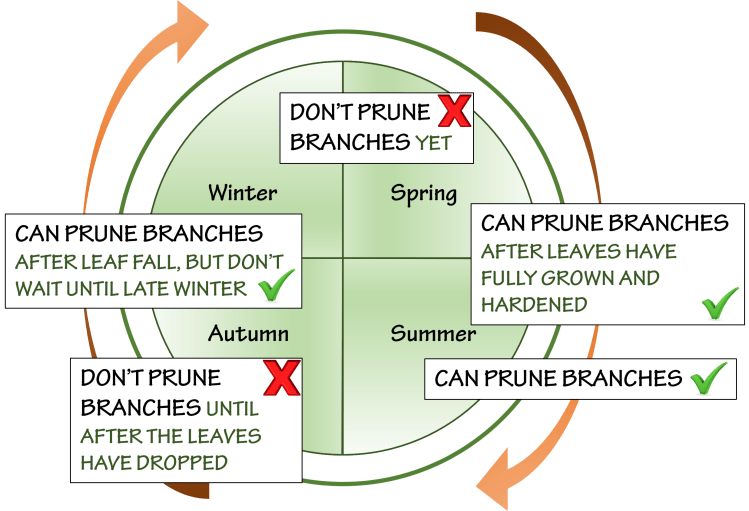
As a simple rule, you can prune a tree’s branches when the tree’s energy is medium or high, but don’t prune them at a time of low energy.
Removing branches during repotting season, while all the sap is surging up the trunk and branches, seriously depletes the tree of all that energy. As well as causing additional sap loss from all the cut branches. More details in this video: 10 reasons to prune your bonsai.
The low-energy rule also applies to a tree that has suffered in some way, for example with a massive insect infestation. With low energy, removing a few key branches might topple the tree to a point of no return. It’s always better to wait until you see many new leaves have grown and hardened, so that you know they are generating plentiful energy for the tree.
You also need to apply a certain amount of judgement for each tree. For example, “winter pruning” sounds like it could be any time during the months of winter; whereas in reality, it should normally be done in early winter – or late autumn – shortly after the tree goes dormant. If you leave it too late in winter, the tree could be “waking up” for the growing season, and you run the risk of losing a lot of sap and energy. If you leave it this late, you should be considering whether it needs repotting, and leave branch pruning until much later in spring.
Using fertilizer
In winter, deciduous and coniferous trees are dormant, so any fertilizer you add to the soil is simply wasted. It won’t do any harm if you still have some slow-release fertilizer on there; it’s just not doing anything for your tree.
For the rest of the growing season, use fertilizer per manufacturers’ instructions (or use less!) Only stop adding fertilizer if the summer temperature exceeds about 35ºC (95ºF), because in those conditions trees go “semi-dormant” and all the water goes to transpiration for cooling, rather than photosynthesis for energy production. For more details, I strongly recommend you read the chapter Fertilizer science in the book, Bonsai, the Blue Sky way.
Tropical trees
Assuming you’re keeping your tropical bonsai warm indoors over winter, you can repot or prune tropical trees at any time of year.
In my experience, I have seen the safest way to do this while keeping the tree healthy and vigorous, is NOT to prune branches and roots at the same time. If it needs to be root pruned, first prune the branches, then wait a few weeks to see the new top growth starting to push out, then repot it and prune the roots. Like in Spring, plenty of new leaves signal the sap rising up the tree, meaning there is less damage if you prune the roots during that time. See this video on Tropical bonsai.
Also, if you remove a substantial amount of root mass, it is always a good idea to cover the bonsai with a clear plastic bag for a week or two afterwards, misting inside to keep the humidity at or near 100%. This keeps the transpiration to a minimum so that the leaves don’t attempt to draw up much water from the depleted root system. More details in this video: Reviving a dying bonsai – the Magic method.
Copyright © 2025 Blue Sky Bonsai. All text, images and videos in this article are copyrighted by Blue Sky Bonsai. Please contact me if you’d like to share or reference this material.


Superb reaction to readers requests and suggestions, “more power to your elbow”
Keep up your good work, please!!!
LikeLiked by 1 person
Thank you Alan! Hope you’re feeling better and able to start your repotting soon!
LikeLike
loved the 24 minute video thank you an as a result I’ve just now ordered a couple of elephant plants (one to ruin and one to progress!!)
Didn’t realise just how much work goes into an 8 minute video, I have enough trouble remembering to take a photo before and after doing work on a project.
Must be a pretty good camera you use
Thanks for your efforts
LikeLiked by 1 person