
In a recent video, I discussed the advantages and disadvantages of these five methods of watering your bonsai:
- The good old watering can
- A hose with a fine spray nozzle
- Dunking or submerging the whole pot in water
- A water box with a wick (Hydrobonsai)
- An automatic watering system
Before we compare those methods, here are some tips for the most healthy bonsai watering…
How much to water
Firstly we have to consider that each tree species has its own needs, and these are different from season to season, from your climate to mine, and even from pot to pot, and of course the soil you’re using in that pot.
There is no single prescription that applies to all bonsai like: “water all bonsai every day”, or “wait until the soil is dry and then water”. These might be appropriate for onespecies in summer, but completely different for winter or for another species.
But there is one rule that applies to all species, and that is:
All trees must receive sufficient water to survive.
If you repeatedly let the roots get dry,then there is a much greater likelihood that your tree is going to die than it would with damp soil. I can tell you from my experience and from others: far more trees die due to the soil drying out than due to over-watering.
So when you get a bonsai, just make sure you know its species, and look up any special requirements for it. For example, acid-loving plants like Camellias and Satsuki Azaleas don’t cope well with alkaline water, so you’re better off using rainwater for those than tap water. However most species are perfectly okay with tap water.
Side note: Portulacaria Afra and other succulents like Jade prefer drier conditions than trees. But then they’re not trees; they’re succulents so you water them less.
Some tree species tolerate drying soil better than others. White Pines and Junipers for example, and Holm Oaks and Olives: they can all survive for longer in dry soil than many deciduous trees. But in my experience that does not mean you must water these species less. Just because they tolerate drying, doesn’t mean that they grow better in dry soil.
As long as you have your tree in good draining soil, you can water it and water it again without fearing its death. I have to reiterate, I have never lost a tree by watering it too much. But then, I don’t use thick loamy soil or dense peat that doesn’t allow drainage. I use granular soil that allows the best drainage and encourages the most healthy root growth. I also don’t let my trees stand in a puddle of stagnant water that’ll gradually rot the roots.
“I have never lost a tree by watering it too much.”
Be aware that most granular soils retain less water than peat, so you will need to water more frequently.
Also be aware of the season, because even in Madrid in winter, it’s cold enough
that I can leave the trees for a week at a time without the soil getting dry. And deciduous trees in their dormant period can go for a few weeks without watering.
So a very important difference: three times a day in summer versus three weeks without watering in winter.
If you’re in any doubt, just put your fingers on the soil, and if it doesn’t feel wet to the touch, give it a good watering.
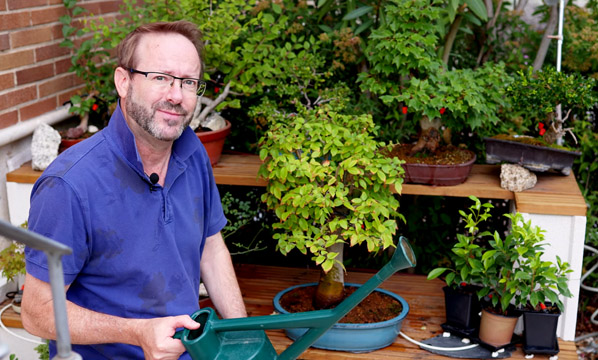
How to water your bonsai
As a quick reminder: when you water your bonsai make sure that the water goes right through the soil and actually comes out the bottom of the pot.
And don’t keep the pot on a plate or a tray.
Water the soil directly and keep watering until you see the the water come out the bottom. If the soil has been allowed to get really dry then you might actually need to water twice. Leave it five to ten minutes and water again just to make sure that all of the soil really has absorbed water and it’s not just passing through leaving chunks of soil dry.
If your tree has a wide trunk base, it’s really important to make sure that the soil under the trunk gets wet too.
And now about so-called “indoor” bonsai. Outside you can water as much
as you like and splash, and let the excess water run off into the ground. But that’s not practical indoors.
Indoors, rest the pot on a drop tray, and water the soil in the pot until the tray fills up a bit. Then pour that water away so that the bonsai pot is not standing in a puddle of water in the tray.
Five watering methods: the comparison
Watering can
As the old (and bad) joke goes: What can keep a tree alive? Watering can.
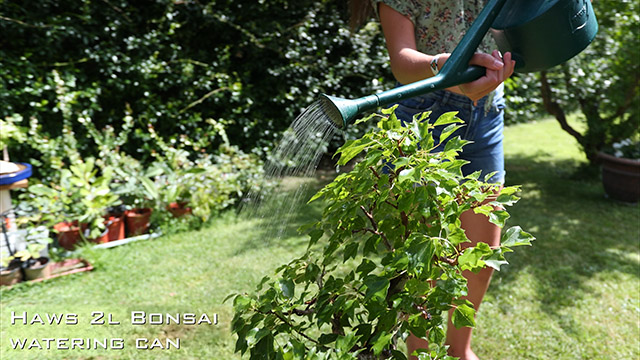
I use a Haws 2L bonsai watering can because of its weight and balance, and its fine nozzles are perfect for granular bonsai soil, because you don’t want to be moving the granules around with a thick torrent of water.
There are some very useful advantages of a watering can:
- Firstly you can easily add liquid fertilizer.
- You can use stored rain water and that’s especially good for acid-loving trees.
- Watering cans are excellent for getting the right amount of water for each pot.
And now here are the disadvantages:
- Stored rainwater usually contains floating particles like pollen. It can block up the nozzles of the watering can pretty quickly.
- Another disadvantage is that 2 litres of water doesn’t go very far, and that means a lot of trips back to the water tank it can take a lot of time to water all of your trees.
and that brings us on nicely to the second method for watering your bonsai:
Hose pipe with a fine spray nozzle attachment
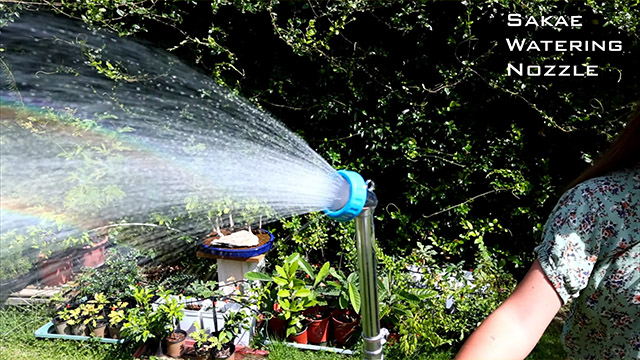
Again the very fine jets of water are perfect for granular bonsai soil.
The single biggest advantage of this method of watering is it’s much faster than the watering can.
But there are quite a few disadvantages of this method:
- Firstly, if the hosepipe has been in the sun then you have to let out all the hot water first before you water anything because you don’t want to water your trees with piping hot water.
- Secondly, you can’t add liquid fertilizer, at least not easily, to a hose pipe system.
- Thirdly, where you’re watering is actually limited by the length of the hose. You can’t reach pots that are further away than the hose length.
- Fourthly you can’t use rainwater unless you set up a pump system from a tank.
- A fifth disadvantage potentially depending on your situation: a hose pipe system is not practical for watering indoor bonsai, so you’re going to need a watering can as well in any case.
Dunking / immersion
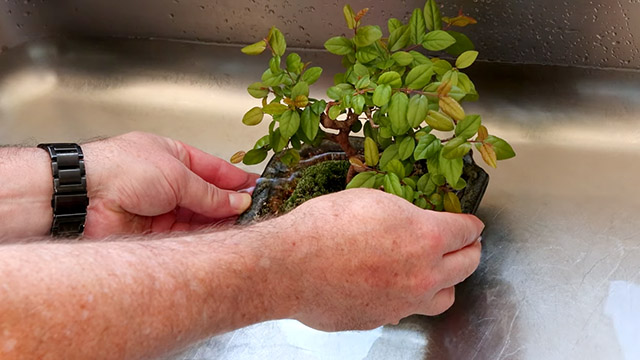
The third method for watering your bonsai is immersion. That is, submerging the entire pot underwater. Dunk the pot into the water so the soil surface is just below the water level, and leave it submerged for 5 or 10 minutes.
I find this method a bit weird and inconvenient, but there are a couple of advantages:
- Some organic soil types repel water when they’re completely dry like peat moss. Dunking in water slowly rehydrates all of the soil.
- The second advantage of this method is that you can watch the amount of air bubbles that are produced underwater: a gauge of how dry the soil was.
Disadvantages:
- I personally don’t like dunking my bonsai to water them because it rearranges the soil somewhat. It moves the lighter soil (like perlite and pumice) up to the surface, and I’d rather keep the soil composition as I’ve potted it.
- It is very impractical if you have more than a couple of trees in pots, and cascade pots that are typically tall.
- If you do this repeatedly, the salts and minerals in the soil accumulate on the surface of your soil and you get a yellowy white crusty substance around the rim of the pot and on the topsoil.
Hydrobonsai
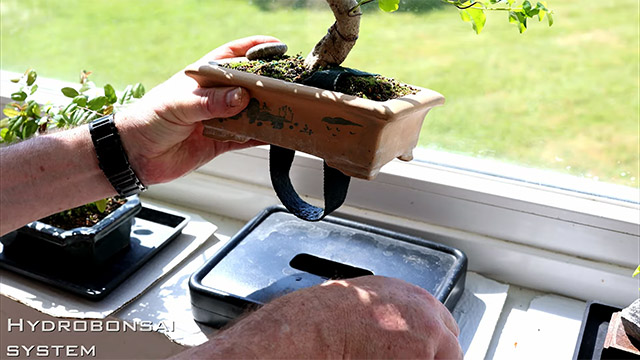
And now my fourth method: this is the water box with a cloth wick to keep the soil damp. Hydrobonsai is another name for this method.
At first I was very sceptical about it because nothing good comes from sitting a bonsai on top of a pool of water, but this summer while I was away I tried it for some of my indoor bonsai. I left them for two weeks and was pleasantly surprised to find no ill effects. In fact, they had all grown normally and healthily.
So a clear advantage of this method is it’s good for indoor bonsai for a short period of time of two or three weeks.
But the disadvantages are:
- The wick is tricky to put into the water holes of the bonsai pot. You basically have to take the whole soil mass and root ball out of the pot to do that, and in some cases – like for a recent repot – this is just not possible.
- And a long-term disadvantage of this method, it doesn’t suck air through the soil like watering with a can does, so you’re not giving the roots the most healthy conditions.
Automatic watering system
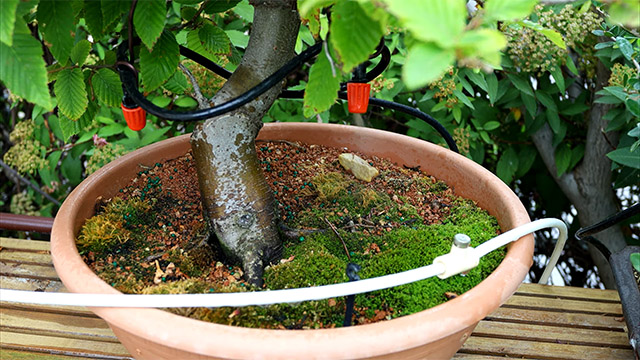
This is a big one to discuss. I will cover automatic watering systems in my next post and video.
Q&A
Question: Does it matter for the foliage if you water them when they are in full sun?
Dave’s answer: Excellent question about watering the foliage in full sun.
For broadleaf evergreens, like olives or azaleas, I don’t water their leaves with tap water at all, because they can keep their leaves for over a year, and I don’t want calcium deposits or other chemicals to build up on the leaves.
However, If the tree is deciduous, it doesn’t matter because it will lose its leaves in autumn anyway (or even earlier if you defoliate) so any calcium deposits are short-lived.
On the question of whether water droplets on leaves magnify the sunlight and burn the leaves? I believe that’s just a myth, I’ve watered the deciduous leaves in full sunlight for several years here in Madrid and never noticed any leaf problems as a result. The water evaporates off quicker than it could burn a leaf. Otherwise we’d see millions of burnt spots on tree leaves everywhere in nature, whenever there’s sun and rain together.
In theory, if a water droplet is suspended by tiny wax hairs above the leaf surface then it could burn the leaf surface because the water itself is not cooling the surface. But even then, the water tends to evaporate fast enough that no real damage is done. Here is a scientific (phytology) paper on the effect of sunlight on water droplets on leaves.
Question: where can I find the 2l watercan? i only can find a 0,9l or 5l can.
Dave’s answer: sadly I also can not find the 2 litre can any more. I bought mine a few years ago on Amazon but looks like Haws don’t make this model now. I am going to contact them because a few people have asked the same. In the meantime, you could try their “fine as rain” rose on another brand watering can.
 Blue Sky Bonsai