
Here are some questions I have received about bonsai soil, with my answers:
Question: When you mention good soil could you give examples of this? My biggest fear is the soil not being suitable … When you say that over-watering is not possible I feel very safe knowing that! But now I’m concerned about my soil.
Dave’s answer: The single most important aspect of the soil is that it allows good drainage and holds its structure so that it will still have good drainage after 1 year. Or 2 years. Or more. But it also needs to retain some of the water and nutrients, so for example, small gravel is not good unless you’re prepared to water it many times a day.
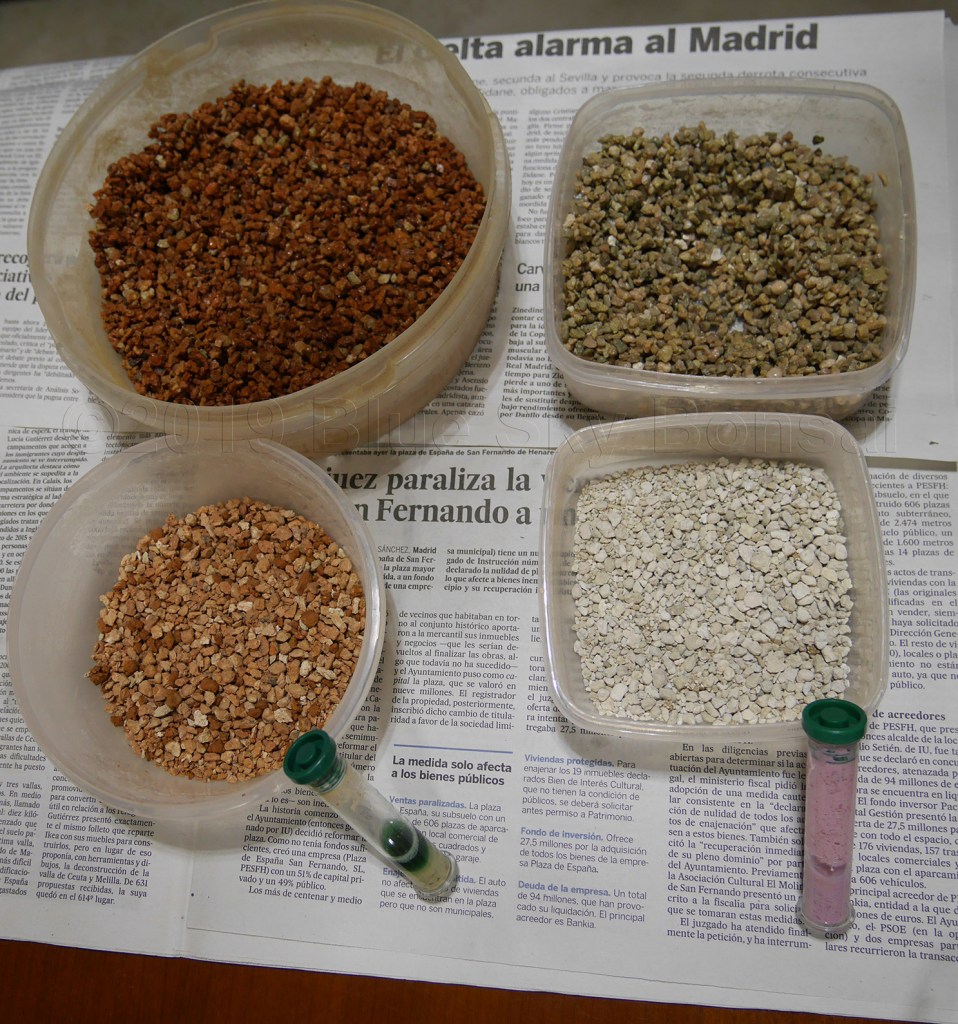
It’s good to mix some harder components like pumice with some more absorbent components like akadama or pine bark so you get both structure and retention. Seramis does both, like some fired clay aggregates and also Sanicat Pink cat litter but be careful because not all cat litter is suitable. Clumping is bad, dust is bad.
“The single most important aspect of the soil is that it allows good drainage and hold its structure. But it also needs to retain some of the water and nutrients.”
Dave Bluesky
Question: I bought a small bag of bonsai potting mix which contains ‘seramis’ which is apparently good for retaining water etc. It seems to me like ordinary compost but maybe finer. I’m in UK and most of the trees will be in a green house for the winter and outside in the summer. I’m curious what soil you are using here in your video? Is it worth me looking for the granule type soil you’re using?
Dave’s answer: Seramis is very good as long as it’s granular, not powder. The powder will clog up all the air gaps and pores between the granules and those air gaps are essential for allowing oxygen down to the roots, and for encouraging root growth.
So, even though we sometimes buy pre-mixed bonsai soil, I always seive it to get rid of any dust or fine particles. 2mm is the smallest I would use but ideally use 4-5mm soil granules. My soil is a mix of akadama + pine bark + kiryuzuna (which is a bit like pumice). All seived. I’ve found the particle size is more important than the exact ingredients of the soil. A couple of exceptions: if you have an azalea or a camelia, they need acidic granular soil, so look for “kanuma” if you have those.
“Ideally use 4-5mm granules. With a few exceptions, the particle size is more important than the exact ingredients of the soil.”
Dave Bluesky
Question: What repotting mix are you using for the sageretia theezans? I’ve recently received one that was kept indoors & noticed a white fuzzy mould on the roots/soil. I’ve been advised this might be due to the soil retaining too much moisture & was wondering what type is ideal to replace it with?
Dave’s answer: I mix the soil approximately 50% akadama and 50% crushed pine bark all seived to approximately 2-3mm granule size, to get rid of the dust so there is always good drainage, and to get rid of the bigger chunks of bark that are too big for a small pot. I talk a bit about the soil mix for Sageretia Theezans here: https://youtu.be/ZlnyM6IuDpo?t=526 – it’s the same soil mix that I use for a lot of smaller “shohin” size bonsai, and the granule size (2-3mm) is smaller than I use for my bigger bonsai that have bigger root systems and larger pots.
Question: What cat litter do you use for bonsai soil?
Dave’s Answer: I live in Spain and I bought the local supermarket “Al Campo” non-clumping cat litter, about 2 years ago – I bought about 10 large sacks of it. It is very similar to Sanicat Pink if you can get that, or Tesco dust-free cat litter. I tried a few different bags from different shops before I found this one. Other brands disintegrated too easily in water, or clumped together creating a mush. This year I went back to Al Campo to buy more of this pink type, and unfortunately they don’t sell it any more so I’ll have to go back to akadama + pumice.
 Blue Sky Bonsai